

Two days, two walking routes and two sides of Berlin: the city that shaped European history and the creative, multicultural capital of today. Save the maps and get ready to explore Berlin one step at a time.
Berlin is a city that surprises you. It may not have Paris’s grand elegance or Rome’s classical appeal, but it wins you over with its history, creative energy and constant ability to reinvent itself.
If you’re visiting the German capital for the first time, we’ve put together a two-day itinerary you can follow on foot, linking the main attractions with some of the city’s most characterful neighbourhoods and local hangouts.
Day one focuses on the Berlin that shaped European history, taking in many of its best-known landmarks. Day two explores the contemporary city, from street art and independent cafés to popular meeting spots.
Read on and save both maps to follow the routes easily during your trip.
Day 1: The Berlin That Shaped Europe
Your first day takes you through the historic heart of the city. Along the way, you’ll encounter places that tell the story of Prussia’s rise, the devastation of the Second World War, the division of the Cold War and the rebirth of modern Germany.
Berlin Walking Itinerary: Day 1 Map

9:00 am: Start Your Day at the Brandenburg Gate
- Suggested visit time: 20–30 minutes
- Nearest U-Bahn/S-Bahn station: Brandenburger Tor
There’s no better place to begin exploring Berlin’s history. A symbol of the city and German reunification, the Brandenburg Gate has witnessed some of the most significant events in European history over the past two centuries. Today, it represents a Berlin that’s open, cosmopolitan and looking to the future.
10:00 am: Visit the Reichstag
- Suggested visit time: 1 hour
- Nearest U-Bahn/S-Bahn station: Bundestag
- Walking distance from the Brandenburg Gate: Around 7 minutes
A short walk brings you to the Reichstag, home of the German parliament. Its striking glass dome, designed by Norman Foster, offers panoramic city views and symbolises transparency in German democracy.
Tip: Book your visit to the dome in advance, especially if you’re travelling during peak season.
Visualizza questo post su Instagram
11:30 am: Stroll Along Unter den Linden
- Suggested visit time: 30–45 minutes
- Walking distance from the Reichstag: Around 15 minutes
Continue your historical walk along Unter den Linden, Berlin’s best-known boulevard. Lined with historic buildings, embassies and cultural institutions, it connects the Brandenburg Gate with Berlin Cathedral, passing the State Opera, Humboldt University and Schlossbrücke (Palace Bridge) along the way.
12:30 pm: Have Lunch in Nikolaiviertel, Berlin’s Oldest Neighbourhood
- Nearest U-Bahn station: Klosterstraße
- Walking distance from Unter den Linden: Around 15 minutes
After exploring Unter den Linden, head to Nikolaiviertel, the city’s historic core. Rebuilt to reflect the appearance of its original medieval streets, the neighbourhood is now home to cobbled squares, traditional-style buildings and some of the most characterful restaurants in central Berlin. It’s a pleasant place to take a break before spending the afternoon on Museum Island.
Where to Eat in Nikolaiviertel
- Zur Gerichtslaube
- Zum Nussbaum
- Brauhaus Georgbräu
Visualizza questo post su Instagram
1:30 pm: Spend the Afternoon on Museum Island
- Suggested visit time: 2–3 hours
- Nearest U-Bahn station: Museumsinsel
- Walking distance from Nikolaiviertel: Around 5 minutes
A UNESCO World Heritage Site, Museum Island brings together five major museums dedicated to European and Mediterranean art and culture, with collections spanning from prehistoric times to the 19th century.
You won’t have time to visit them all, so which one should you choose?
For a first visit, we recommend the Neues Museum, one of the island’s best-known museums and home to the famous bust of Nefertiti. Its collections cover several historical periods, while the building combines surviving original features with contemporary architecture. If European painting is more your thing, opt for the Alte Nationalgalerie instead.
Tip: Book a guided walking tour of historic Berlin with a Museum Island pass to hear local insights, fascinating facts and stories from an expert guide.
Visualizza questo post su Instagram
5:00 pm: Visit Berlin Cathedral
- Suggested visit time: 45 minutes
- Walking distance from Museum Island: Around 5 minutes
Round off your historical walk with a visit to Berlin Cathedral, one of the city’s most striking and recognisable landmarks. Admire the Neo-Renaissance-style interior and, if time allows, climb to the panoramic dome for views over the historic centre.
One thing to keep in mind: The cathedral closes at 6:00 pm.
Evening: Explore Hackescher Markt
- Nearest S-Bahn station: Hackescher Markt
- Walking distance from Berlin Cathedral: Around 10 minutes
End the day in Hackescher Markt, an area known for its restored courtyards, restaurants, independent shops and bars. Before dinner, explore the Hackesche Höfe courtyards and the surrounding streets, where historic Berlin meets the city’s creative, contemporary side.
It’s also a great place to stop for a craft beer, enjoy a traditional meal or carry on into the evening with some live music.
Where to Eat in Hackescher Markt
- Das Lemke
- Transit Restaurant
- Hackescher Hof
Visualizza questo post su Instagram
Day 2: Berlin Like a Local
Day two is all about the city’s creative, contemporary side. From street art and international neighbourhoods to expansive public spaces, you’ll get a feel for the Berlin people experience every day.
Berlin Walking Itinerary: Day 2 Map
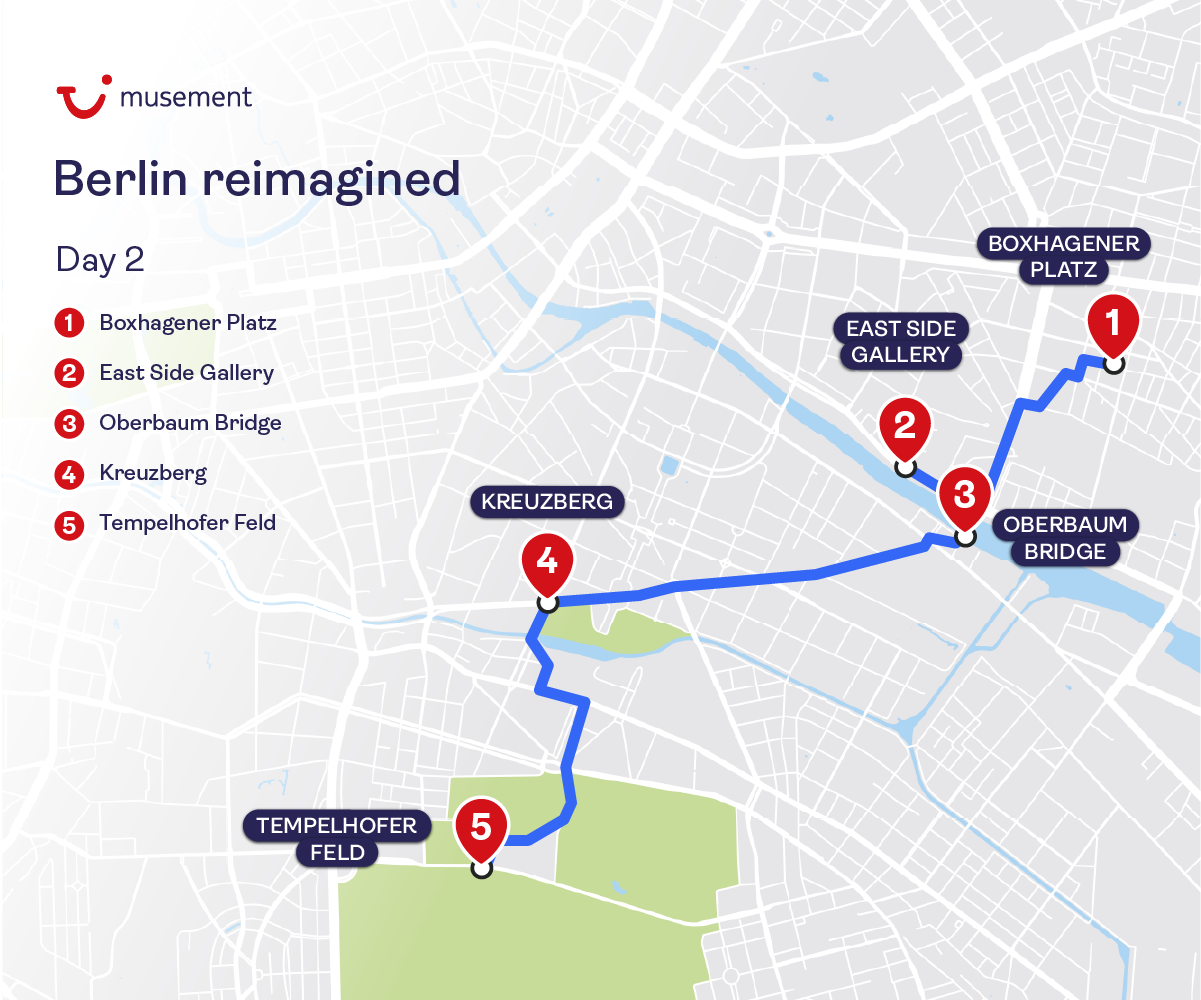
9:00 am: Start Your Day at Boxhagener Platz
- Suggested visit time: 1 hour
- Nearest U-Bahn station: Samariterstraße
In Friedrichshain, Boxhagener Platz is a popular local meeting spot. You’ll find independent cafés, small shops, markets and a laid-back atmosphere. For breakfast, stop by 19grams Boxi, a small café that’s become a neighbourhood favourite. Order a specialty coffee with a slice of cake or a sandwich before continuing towards the East Side Gallery.
10:30 am: Explore the Murals at the East Side Gallery
- Suggested visit time: 1–1.5 hours
- Nearest S-Bahn station: Warschauer Straße
- Walking distance from Boxhagener Platz: Around 20 minutes
The East Side Gallery preserves the longest remaining stretch of the Berlin Wall. Today, more than 100 murals have transformed what was once a symbol of division into one of the world’s best-known open-air art galleries. Look out for Dmitri Vrubel’s My God, Help Me to Survive This Deadly Love, better known as the Fraternal Kiss, and Birgit Kinder’s painting of a Trabant appearing to break through the Wall.
Tip: Start at Warschauer Straße station and walk along the gallery towards Oberbaum Bridge, the next stop on your itinerary.
Visualizza questo post su Instagram
12:00 pm: Cross Oberbaum Bridge
- Suggested visit time: 20 minutes
- Nearest S-Bahn station: Warschauer Straße
- Walking distance from the East Side Gallery: Around 5 minutes
This elegant brick bridge connects Friedrichshain and Kreuzberg. During the Cold War, it marked the boundary between East and West Berlin. Today, it’s one of the city’s best-known symbols of reunification. Walking across is an easy and scenic way to get from the East Side Gallery to Kreuzberg. The pedestrian walkway runs beneath the U-Bahn tracks, offering lovely views of the river, the remaining stretch of the Wall and the city skyline.
Once across the bridge, you’ll arrive in the Schlesisches Tor area, one of the gateways to Kreuzberg.
12:30 pm: Have Lunch and Explore Kreuzberg
- Suggested visit time: 2–3 hours
- Walking distance from Oberbaum Bridge: Around 5 minutes
Creative, multicultural and full of character, Kreuzberg is one of Berlin’s most interesting neighbourhoods. To refuel, head to Markthalle Neun, an indoor market filled with food stalls, artisan produce and street food. It’s an ideal spot for a relaxed lunch.
Afterwards, explore Skalitzer Straße and Oranienstraße, two well-known streets where street art reflects the neighbourhood’s alternative, multicultural identity.
Then make your way to the Landwehr Canal for a walk along the water. On sunny days, its banks become a popular gathering spot for local residents. If you’re visiting on a Tuesday or Friday, you can also browse the stalls at the Maybachufer Turkish Market, where you’ll find fresh produce, spices, textiles and food specialities.
Visualizza questo post su Instagram
4:00 pm: Head to Tempelhofer Feld
- Suggested visit time: 1–2 hours
- Nearest U-Bahn station: Leinestraße
Few places capture Berlin’s spirit quite like Tempelhofer Feld. Once a city airport, this vast site has been transformed into one of Europe’s largest public spaces. Today, it’s a favourite with cyclists, skaters, families and groups of friends.
It’s the kind of place you won’t find in many other European capitals, offering a glimpse of Berlin’s distinctive character.
Tip: If it rains or the weather doesn’t cooperate, book a guided tour inside the former airport. You’ll explore hangars, terminals and underground areas while learning about some of the more complex chapters of Berlin’s history, from the Nazi era to the 1948–1949 Berlin Airlift.
Evening: Catch a Live Event
There’s no better way to experience Berlin like a local than by spending an evening enjoying its thriving cultural scene.
From major concerts to theatre performances, there’s always something happening in Berlin. Check the events calendar to see what’s on during your stay.
Visualizza questo post su Instagram
FAQ: Visiting Berlin in 2 Days
Can you explore Berlin on foot?
Yes, many of the attractions in central Berlin are within easy walking distance of one another. This itinerary groups the stops into logical routes, so you can explore on foot and keep public transport journeys to a minimum.
Is 2 days enough to visit Berlin?
Two days are enough to see the main attractions and get a feel for the city’s atmosphere. Berlin has plenty more to offer, of course, but a weekend gives you time to visit its best-known historic landmarks and explore some of its most interesting contemporary neighbourhoods.
When is the best time to visit Berlin?
Spring and early autumn are among the best times to visit Berlin. Temperatures are generally pleasant, and the days are long enough to explore on foot. Summer is also popular, thanks to the many outdoor events and beer gardens.
Where should you stay in Berlin for a weekend?
For a first visit, consider staying in Mitte, Friedrichshain or Kreuzberg. These neighbourhoods have good transport links, plenty of restaurants and attractions, and convenient access to most of the stops on this itinerary.
How many kilometres will you walk on this itinerary?
Expect to walk around 8–10 kilometres each day, spread across sightseeing, stops and breaks in the neighbourhoods along the way. It’s a manageable pace for most travellers, with plenty of opportunities to stop and take a breather.
Is Berlin a good destination for a weekend with children?
Yes. Many of the attractions on this itinerary are suitable for families. Open spaces such as Tempelhofer Feld, the East Side Gallery and the areas around the River Spree also offer plenty of room for children to explore.
Which Berlin attractions should you book in advance?
If you plan to visit the Reichstag or any of the museums on Museum Island, we recommend booking ahead, especially during busy periods such as summer and December. This can help you avoid long waits and last-minute planning.
Related post
Some beaches you visit for a day, while others stay with you for years. These…

Two neighbouring islands, two very different ways to experience the Canaries:…

Discover 10 iconic films set in Italy and the experiences that let you step…